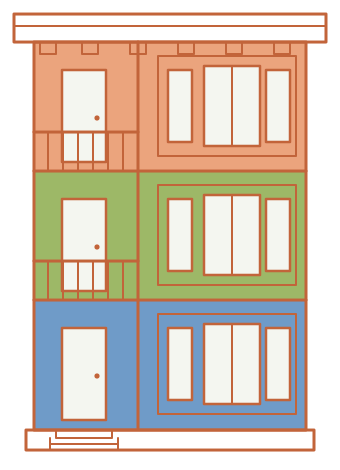
A local problem requires a local solution. To own the triple-decker homes of Greater Boston, collaboration is needed.
Investors have been buying Boston's most common housing type for generations and making a profit by renting them out for more than it costs to pay for it.
*
is each household's share of a three-family home, the median price in over the past 6 months, compared to the recent median condo price of .
/mo
is the estimated full monthly cost of owning that three-bedroom unit, against the median rent in of .
*Estimates, not a quote, for one three-bedroom unit in a three-family home bought by three households, at 10% down and a 7% fixed rate, including mortgage insurance, property tax after the residential exemption, insurance, a building reserve, and water and sewer.
What is Co-Buying?
Co-buying is when multiple households buy one building together. Each household has their own unit and the group shares the mortgage, insurance, and the costs of building upkeep & maintenance. Before anyone buys, each household signs a legally binding co-ownership agreement that settles how costs are split and what happens when someone wants to sell. The same model would work for a group of friends buying a house to share. See our guide to co-buying in Massachusetts for a deeper dive to learn more.
Groups have bought buildings together for decades, but until now they've had to learn how to do it from scratch.
Co-buying has added elements that should be considered carefully: splitting a down payment fairly, creating a shared budgeting system, and agreeing on what happens when someone wants to move out. HomeMates is the first service built to guide a group through the full process.
Group Formation
Patti Lautner
Patti co-founded Jamaica Plain Cohousing, managed the 30-unit project through development, and has lived in community there for more than 20 years. She knows firsthand how a group makes decisions, splits costs and handles a household moving on.
Property and financing
Aidan Regan
Aidan spent five years in real estate brokerage working with investors and developers on how deals get underwritten and financed. He brings that same analysis to every building you consider, down to each household's share and its monthly cost.
We're taking 5 groups to ownership through our January cohort. Reach out if you want to be one of them! See the cohort
Not necessarily. Each household has its own unit, kitchen and bathrooms. However, purchasing can involve splitting a unit with a partner or friend. We would work through the in-unit dynamics as well as the relationship between each household and the larger property.
Does this only work for three-unit buildings?
No, this can work for any property type! We use this example because it's familiar to people and it makes the math easy. But the concept of purchasing with others can extend from single-family homes to larger apartment buildings, even to land and commercial property.
Do I need a group before I reach out?
No. Many people start on their own, and either through our events or our network are able to fill the rest of their group with value-aligned households.
What happens if one household wants to sell later?
Your co-ownership agreement sets that out before anyone buys: who gets the first chance to buy the share, how the price is set, and what happens if nobody does. Some groups also plan to convert the building to condominiums later, so each household can sell its unit on its own.
How does the mortgage work with three households?
There are multiple structures this could take shape as, but the two most common are Tenancy-in-Common, where all owners are on the mortgage, or an LLC that each owner holds a share of. We line up each household's pre-approval and organize the documents so the lender can read the group as a single application.
Does this only work in Boston?
No. We're based in Boston and most of our current clients are in the area, but this model can be replicated anywhere. Remember, the more affordable the market you're looking in, the bigger the project you can do with multiple people!
Find out in 5 minutes whether your household could buy next year.
Answer five questions and you'll see what a share of a typical three-family home could cost your household, whether you'd qualify for the City's help, and if you're not there yet, how long it could take you to get there.
Your buying budget
Monthly cost to own
Share of your income
Cash you'd need
Down payment with City assistance*
Leave your phone or email and we'll message you with what's possible for your household.
These numbers assume a typical Boston three-family home, or the price your income can carry, split evenly between three households, with 10% down on a 30-year fixed loan at 7%, mortgage insurance at 0.75% of the loan a year, Boston's FY2026 property tax after the residential exemption, insurance at 0.5% of the price a year, a $700 monthly building reserve split three ways, $128 a month for water and sewer, and closing costs of about 1.84% of your share. We count a building as within reach when it keeps housing at or under 31% of your income, the FHA guideline, and we don't assume you'll get the City's down payment assistance, though if you qualify it can lower the cash you'd need. They also assume the other households earn about what yours does; when incomes differ, a group can split ownership and monthly costs to match, which is one of the things we work out in Group Formation.